
A Broward County property manager recently shared a story that perfectly illustrates the real cost of neglecting roof maintenance. After skipping routine inspections for three years to “save money,” a small drainage issue on their commercial flat roof led to interior water damage totaling $47,000. The roof repairs? Just $1,200. The painful irony? A preventive maintenance plan would have cost them about $800 annually and caught the problem before it became catastrophic.
This scenario plays out across South Florida more often than it should. Many property owners view roof maintenance as an optional expense rather than a strategic investment. But after seven decades of protecting Broward County roofs, we’ve seen the math work out the same way every time: preventive maintenance isn’t just cheaper than emergency repairs—it’s dramatically cheaper.
The Real Numbers Behind Preventive Roof Maintenance
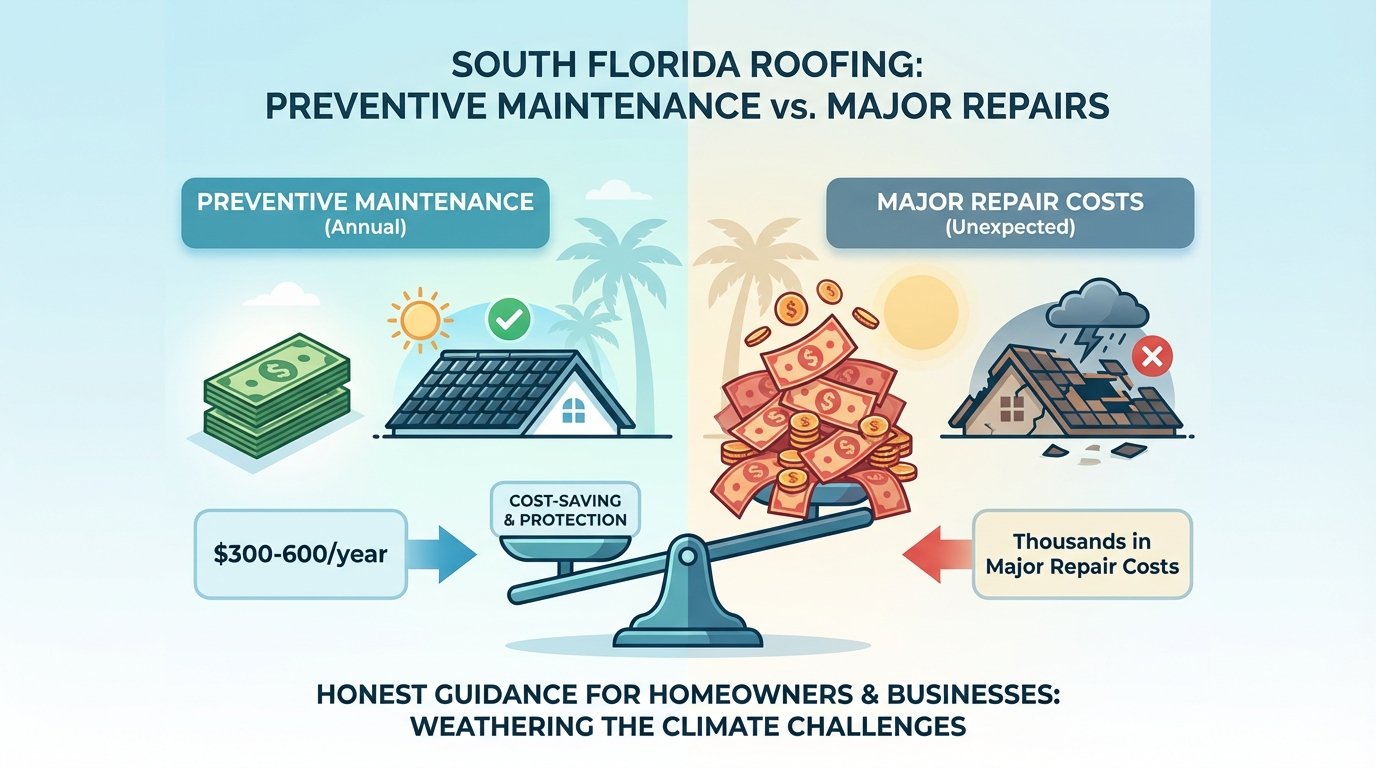
Let’s talk about actual costs, because that’s what matters when you’re managing a property budget. A typical residential roof maintenance plan in Broward County runs between $300 and $600 annually, depending on your roof size and type. Commercial roofing maintenance costs more—usually $800 to $2,500 yearly—but the return on investment becomes even more compelling when you’re protecting a larger asset.
Compare those figures to common repair costs we see regularly:
- Minor leak repair: $500-$1,500
- Flashing replacement: $800-$2,000
- Flat roof ponding water correction: $1,500-$4,000
- Interior water damage restoration: $3,000-$50,000+
- Emergency roof replacement due to neglect: $15,000-$100,000+
Here’s the critical insight from decades of roof inspection work in Florida: most major roofing problems don’t appear suddenly. They develop slowly over months or years, giving you multiple opportunities to address them inexpensively—if you’re actually looking.
What South Florida Weather Does to Unprotected Roofs
Broward County’s climate creates a perfect storm of roofing challenges that make preventive maintenance especially valuable here. This isn’t Minnesota or Oregon—our roofs face unique stressors that accelerate deterioration.
The relentless UV exposure breaks down roofing materials faster than almost anywhere else in the country. Asphalt shingles that might last 25 years up north often need replacement after 15-18 years here. Flat roof membranes become brittle and crack. Sealants dry out and fail. This happens whether you’re paying attention or not.
Add our humidity levels, and you’re creating conditions where algae, mold, and mildew thrive on roof surfaces, particularly on north-facing slopes that stay shaded. Left unchecked, these organisms don’t just look bad—they actually hold moisture against your roofing materials and accelerate decay.
Then there’s our seasonal reality: hurricane season arrives like clockwork every year. A roof with minor vulnerabilities—loose shingles, compromised flashing, weakened attachments—might handle normal weather just fine. But when a tropical storm or hurricane pushes through, those minor issues become major failures. We’ve seen entire sections of roofing tear away because a few fasteners had worked loose over time, something a simple inspection would have caught.
The Preventive Commercial Roof Maintenance Difference
Commercial properties face even higher stakes with roof neglect. Flat roof maintenance in Florida requires particular attention because these low-slope systems don’t shed water naturally like residential pitched roofs. When drainage slows even slightly, water sits longer on the membrane, finding every tiny weakness.
A commercial property owner in Fort Lauderdale recently told us they’d been quoted $180,000 for a complete roof replacement on their 15,000 square-foot building. The roof was only 12 years old—it should have had another 8-10 years of life. What happened? No preventive commercial roof maintenance program. Small membrane punctures from debris went unnoticed. Drains clogged with leaves and got overlooked. Ponding water gradually deteriorated the membrane until leaks started appearing in multiple locations.
The tragedy? That roof could have been preserved with a maintenance program costing roughly $1,500 annually. Over 12 years, that’s $18,000 in maintenance versus $180,000 in premature replacement. The math isn’t complicated.
Commercial roofing maintenance in Broward County should include quarterly inspections minimum, with additional checks after any significant storm. This frequency catches problems while they’re still minor and keeps your warranty valid—most commercial roofing warranties actually require documented maintenance.
What Effective Residential Roof Maintenance in South Florida Includes
Not all maintenance programs deliver the same value. After decades in this business, we’ve learned exactly what South Florida roofs need to stay healthy and what’s just unnecessary add-ons.
A solid residential roof maintenance program should include:
Comprehensive Visual Inspection
Walking the entire roof surface (when safe) to identify loose, damaged, or missing shingles; checking all flashing around chimneys, vents, and skylights; examining roof penetrations; and looking for any signs of wear that could lead to leaks.
Drainage System Check
Clearing gutters and downspouts of debris; ensuring water flows away from the structure; checking for any areas where water might be pooling on the roof surface.
Attic Inspection
Looking for signs of moisture intrusion, proper ventilation, and adequate insulation—problems here often indicate roof issues developing.
Sealant and Caulking Review
In Florida’s UV intensity, sealants deteriorate faster. Checking and refreshing these as needed prevents water intrusion at vulnerable points.
Minor Repairs
Addressing small issues immediately—replacing a few shingles, re-securing loose flashing, clearing debris—before they become bigger problems.
This work typically takes 1-3 hours for a residential property and catches roughly 90% of potential problems before they cause leaks or damage.
The Hidden Costs of Skipping Roof Maintenance Broward County Owners Face
Beyond obvious repair costs, maintenance neglect creates expenses many property owners don’t initially consider.
Insurance companies increasingly require proof of regular maintenance, especially after claims. We’ve seen homeowners lose coverage or face non-renewal because they couldn’t document basic upkeep. When hurricane season approaches and you’re trying to secure coverage, lack of maintenance history can become a serious liability.
Energy costs rise when roofing systems deteriorate. Compromised roof deck ventilation makes your air conditioning work harder. Moisture intrusion affects insulation performance. These aren’t dramatic changes—you won’t suddenly see your electric bill double—but that extra $30-50 monthly adds up over years.
Property value takes a hit too. When selling, a well-maintained roof with documentation is a powerful selling point. A roof showing obvious neglect triggers buyer concerns, reduces offers, or kills deals entirely. We’ve worked with real estate agents who estimate that visible roofing problems can reduce property values by 5-10%.
When Maintenance Makes Sense Versus When Replacement Is Smarter
Honesty matters here: preventive maintenance isn’t always the right answer. If your roof is already near the end of its expected lifespan, pumping money into maintenance might not make financial sense.
Generally, if your roof has less than 5 years of expected remaining life and needs repairs exceeding 15-20% of replacement cost, replacement becomes the smarter investment. A roof that’s 20 years old with multiple problem areas? You’re probably better off replacing it than trying to patch it along.
But if your roof is relatively young—say under 10 years for shingles or under 15 years for a commercial membrane—maintenance dramatically extends its life and protects your investment. This is especially true in South Florida where our conditions accelerate aging but also where early intervention prevents that acceleration from causing real damage.
A roof inspection in Florida by an experienced professional can give you honest guidance about whether maintenance or replacement makes more sense for your specific situation and budget. Any contractor who automatically recommends replacement without thoroughly assessing maintenance options isn’t serving your best interests.
Building Your Maintenance Strategy
The most effective approach combines scheduled preventive maintenance with responsive care after significant weather events.
For residential properties, we recommend inspections twice yearly—once before hurricane season (April or May) and once after (November or December). This timing catches issues before storms test your roof and assesses any damage afterward while it’s still minor.
Commercial properties benefit from quarterly inspections given their typically larger roof areas and more complex drainage systems. Flat roof maintenance in Florida really demands this frequency because problems develop faster on low-slope systems.
After any named storm or significant hail event, schedule an additional inspection regardless of your regular maintenance schedule. Insurance companies typically allow storm damage claims within a reasonable timeframe, but you need to identify and document damage relatively quickly.
What to Expect From a Professional Maintenance Program
A legitimate roof maintenance program includes detailed documentation of every visit. You should receive written reports with photos showing your roof’s condition, noting any issues found, explaining what was done, and recommending any future work needed.
This documentation serves multiple purposes: it helps you budget for upcoming needs, provides proof of maintenance for insurance and warranty purposes, and creates a history that helps diagnose problems if they do develop.
The best maintenance relationships are collaborative, not transactional. Your roofing contractor should explain what they’re finding in plain language, answer your questions without pressure, and help you prioritize repairs based on urgency and your budget reality. If you need to space out repairs over several months for financial reasons, a good contractor works with you on that timeline rather than pushing everything immediately.
Taking the First Step
If you haven’t had your roof professionally inspected in the past year, that’s your starting point. Whether you’re managing a commercial property or own a home in Broward County, understanding your roof’s current condition gives you the information needed to make smart decisions.
For over 70 years, we’ve helped South Florida property owners protect their investments through honest assessment and practical maintenance strategies. We’re not interested in selling you services you don’t need—we’re interested in being your roofing resource for the next 20 years.
Contact us to schedule a thorough roof inspection. We’ll assess your roof’s condition, explain exactly what we find, discuss whether preventive maintenance or other solutions make sense for your situation and budget, and provide clear pricing without pressure. You’ll leave the conversation understanding your roof better and knowing your options.
Your roof is probably your property’s most important weather barrier. In Broward County’s demanding climate, a little preventive attention goes a remarkably long way. The question isn’t whether you can afford maintenance—it’s whether you can afford to skip it.